
An MBA degree opens the door to a wide range of career paths across industries. Graduates commonly move into roles such as management consultants, financial analysts, marketing managers, and operations leaders. In Germany specifically, the demand for professionals in management jobs Germany continues to grow, particularly in sectors like automotive, finance, healthcare, and technology.
What career paths are available after an MBA?
Accounting
As an MBA graduate, you can find a job as an accountant in various companies. Your work might entail budgeting, performing cost evaluations and managing a company’s revenues and expenses. You will also need to become familiar with computer software programmes for organising financial data and maintaining business records.
Applied business psychology
Business psychology can be used in every facet of a business. Business psychologists have a variety of responsibilities within their company. Your daily tasks may include increasing business efficiency and employee productivity, establishing employee training and development programmes, providing motivational leadership and coaching for employees and more.
Corporate finance
Working in the field of corporate finance means you will be responsible for evaluating the company’s short and long-term investments and financial planning strategies to support decision-making and maximise shareholder value. There are many career prospects in this field, especially for MBA graduates.
eBusiness
You may find a job, for example, as an e-business consultant responsible for advising web-based companies on decisions pertaining to technical operations. By studying e-business, you can successfully combine economic and technical knowledge and create added value for companies and customers.
Education management
Successful education management serves to increase the performance of employees and enable them to climb the corporate ladder. With diverse possibilities for working with students, staff, teachers and districts, the careers available in education management can help educators find a position that best fits their skills, experience and personal goals.
Entrepreneurship
You can start your own business and become an entrepreneur or help others as an intrapreneur. By graduating with an MBA with a focus on entrepreneurship, you will gain an understanding of the challenges of self-employment and corporate development, which will allow you to start your own company on a national and international level.
Health management
Medical and health services managers develop strategies, organise systems and run operations at medical facilities, specific clinical departments or a group medical practice. They are responsible for adapting to complex changes in healthcare laws, regulations and technology.
Retail management
Graduates with an MBA with a focus on retail management are in demand in both the private and government sectors. You can work front-end, like selling and marketing the product or connecting with the customers, or you could work back-end, which includes CRM (Customer Relationship Management), retail analytics, product development, etc.
Industrial management
Industrial managers deal with the entire value chain through to industry-specific management tasks. These tasks include planning, controlling and scheduling the production line, creating and managing systems to solve problems related to waste and inefficiency and much more. Industrial managers are capable of finding jobs at, e.g., manufacturing plants.
Logistics management
Logistics managers have the tasks of planning, organising, controlling and monitoring storage and transport matters and ensuring the appropriate flow of materials. The disposal and recycling of goods are also part of logistics management. Graduates can take on managerial positions in the transport and logistics industry.
Tourism and sports management
Employees in tourism and sports management generally work in public relations and communication. This involves brand loyalty, networking and crisis management. Graduates are familiar with the areas in demand and tasks that are customary in the industry in order to be able to carry out scientific analyses and act in a results-oriented manner.
How does an MBA prepare you for global leadership opportunities?
An MBA is inherently international in scope, equipping graduates with the skills needed to operate in global business environments. This includes cross-cultural communication, strategic decision-making, and leadership in diverse teams.
Graduates often secure roles such as:
- Global project managers
- International business development managers
- Regional directors
- C-suite executives (CEO, CFO, COO)
According to the Graduate Management Admission Council (GMAC), over 90% of employers globally plan to hire MBA graduates, highlighting strong international demand. Additionally, many MBA alumni work outside their home country within a few years of graduation, demonstrating the degree’s global mobility advantage.
What makes PFH’s MBA programme industry-relevant?
The MBA programme at PFH is designed with a strong focus on industry relevance and practical application. The curriculum integrates:
- Real-world case studies
- Leadership and management training
- Industry insights from experienced lecturers
- Flexible, career-oriented learning structures
PFH maintains close connections with industry partners, ensuring that graduates are equipped with the skills employers actually demand. This alignment enhances employability in competitive fields and strengthens prospects for management jobs in Germany and beyond.
Why does an MBA accelerate career advancement?
An MBA is widely recognised as a catalyst for career progression and salary growth. It provides:
- Advanced business knowledge
- Leadership and management capabilities
- A strong professional network
- Credibility in competitive job markets
Statistics underline this impact:
- MBA graduates see an average salary increase of 50–80% post-degree (GMAC).
- Around 87% of MBA graduates are employed within three months of graduation (GMAC).
- In Germany, MBA holders often move more quickly into senior management roles compared to non-MBA peers.
For professionals pursuing an MBA career Germany, the degree significantly improves access to leadership roles, higher salaries, and international career opportunities.
How can you explore MBA roles and career opportunities?
If you are considering your next step, exploring the wide range of MBA career opportunities is essential. From consulting and finance to leadership and entrepreneurship, the possibilities are extensive.
With the right programme, such as the MBA at PFH Private University of Applied Sciences, you can position yourself for success in both German and global job markets.
Take the next step: Explore how an MBA can shape your future career and open doors to high-impact roles worldwide.
Key statistics
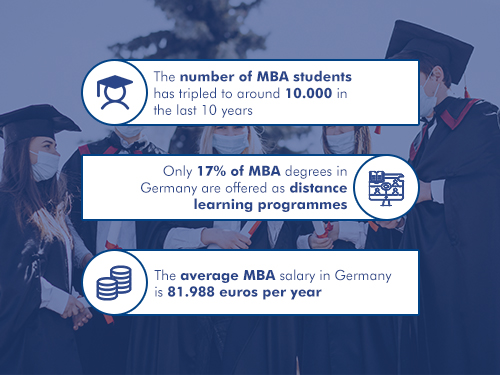
Source of statistics:
- The number of MBA students has tripled to around 10.000 in the last 10 years - https://www.handelsblatt.com/karriere/the_shift/studium-mba-markt-deutschland-viel-masse-wenig-klasse/22579612.html
- Only 17% of MBA degrees in Germany are offered as distance learning programmes - https://www.mba-studium.de/fileadmin/user_upload/Inhalte/mba-studium.de/report/Report-MBA-Studium2016.pdf
- The average MBA salary in Germany is 81.988 euros per year - https://www.glassdoor.com/Salaries/germany-mba-salary-SRCH_IL.0,7_IN96_KO8,11.htm
Post summary
- An MBA career in Germany offers diverse opportunities across consulting, finance, marketing, and leadership
- Graduates benefit from strong global career mobility and leadership prospects
- PFH Private University of Applied Sciences delivers an industry-relevant MBA aligned with employer needs
- An MBA significantly boosts salary, employability, and career progression
- Demand for MBA graduates remains high, especially in management jobs in Germany and international markets